

Shiba Inu is showing early signs of a structural shift, but not in the way most traders expect. Instead of price leading the narrative, on-chain data is beginning to define the asset’s trajectory—highlighting a subtle but potentially meaningful change in market behavior.
Over the past 24 hours, roughly 260 billion SHIB has moved off centralized exchanges, pushing Shiba Inu netflow firmly into negative territory. This shift suggests that a growing share of tokens is being withdrawn into private wallets, reducing immediate sell-side liquidity.
Supply Dynamics Begin to Tighten
Exchange flows often reveal intent before price reacts. In this case, total outflows have exceeded 1.1 trillion SHIB, while inflows have failed to keep pace, resulting in a net negative balance.
At the same time, exchange reserves continue to trend downward. This indicates that the available supply on trading platforms is gradually thinning—a condition typically associated with reduced short-term selling pressure.
Such movements are not isolated. Data also show a more than 1% increase in active addresses, indicating rising network participation rather than stagnation. This combination—declining reserves and increasing activity—has historically aligned with accumulation phases across crypto markets.
Capital Rotation Signals from Large Holders
A closer look at transaction data reveals heightened activity among large wallets, particularly within the top transaction brackets. This suggests that significant holders are repositioning capital rather than exiting entirely.
Large-scale movements during periods of weak or stabilizing price action often reflect internal market restructuring. Instead of aggressive selling, the data points toward redistribution—potentially from short-term participants to longer-term holders.
Price Structure Reflects Gradual Stabilization
While on-chain signals evolve, price action is beginning to echo the shift. After an extended downtrend, SHIB is forming a modest upward structure characterized by higher lows.
At the same time, the asset remains compressed beneath descending resistance, creating a technical tension zone. This type of setup often reflects indecision, where neither buyers nor sellers have fully taken control.
Market Psychology: From Capitulation to Caution
The broader sentiment surrounding Shiba Inu appears to be transitioning. The aggressive selling pressure seen in prior weeks is easing, replaced by more measured positioning.
Negative netflows tend to indicate reduced urgency to sell, but they do not automatically translate into bullish momentum. Instead, they often reflect a cooling phase where participants reassess value and risk.
In this environment, traders are less reactive and more selective, contributing to slower, more controlled price movements.
What Comes Next for SHIB?
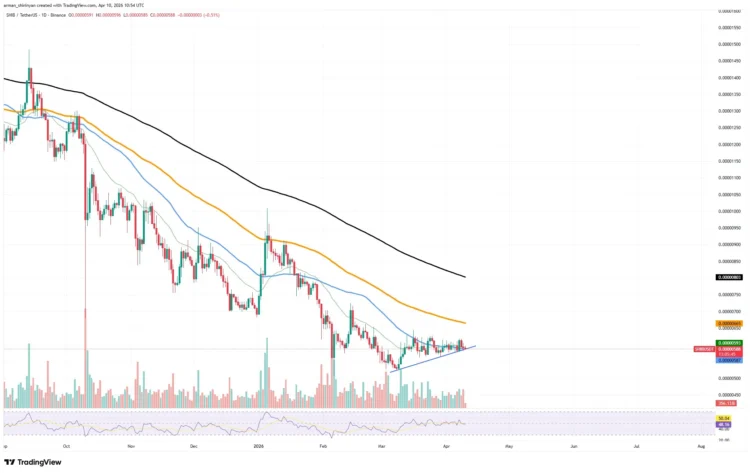
The current data points to a market in transition rather than one in full recovery. The interplay between declining exchange supply, rising activity, and large-holder repositioning suggests that the groundwork for a new phase may be forming.
However, the absence of strong directional conviction keeps SHIB closer to a neutral state than a decisive trend reversal. Whether this evolves into sustained upward momentum or prolonged consolidation will depend on how these on-chain signals continue to develop.
Shiba Inu’s latest on-chain data highlights a shift beneath the surface: supply is tightening, activity is rising, and large holders are repositioning. While price action has yet to fully reflect these dynamics, the market structure is becoming increasingly nuanced, pointing to a period of recalibration rather than clear direction.
Disclaimer: The information in this article is provided for informational and editorial purposes only and does not constitute financial, investment, trading, or legal advice. You should not rely on this content as a recommendation to buy, sell, or hold any cryptocurrency or other asset. Always conduct your own research and, if necessary, consult a qualified financial advisor before making investment decisions. CoinToria Media and its authors are not responsible for any loss or damage resulting from the use of this information.