
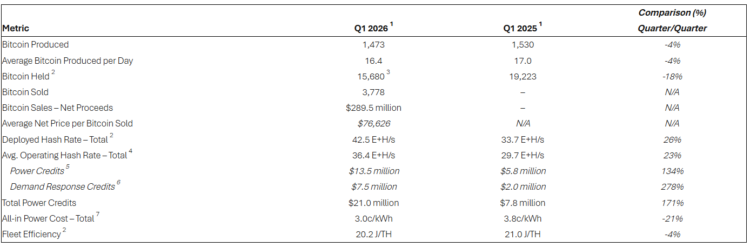
A fresh wave of Bitcoin miner selling is unfolding across the crypto sector, with Riot Platforms liquidating 3,778 BTC in the first quarter. The development highlights mounting financial pressure within the Bitcoin mining industry as rising operational costs force firms to rethink holding strategies.
The sale generated approximately $289.5 million at an average price of $76,626 per Bitcoin. Shortly after, Bitcoin traded significantly lower at $66,867, reflecting a disconnect between miner liquidation timing and broader market pricing.
Riot produced 1,473 BTC during the quarter but still reduced its overall reserves, ending Q1 with 15,680 Bitcoin on its balance sheet.
Adding to the activity, blockchain intelligence firm Arkham detected a 500 BTC outflow from a wallet linked to Riot, signaling continued treasury movement beyond its formal disclosures.
Crypto Miners Selling BTC as Industry Pressure Builds
Riot’s move is part of a broader trend of crypto miners selling BTC under tightening conditions.
In the past week alone, companies including MARA Holdings, Genius Group, and Nakamoto Holdings sold a combined 15,501 Bitcoin. MARA accounted for the majority of those liquidations, reinforcing the scale of the shift.
The trend underscores how miners often seen as long-term holders are increasingly acting as consistent sources of market supply.
Rising Energy Costs Drive Bitcoin Mining Profitability Pressure
At the center of the trend is a sharp increase in energy costs, a critical factor affecting Bitcoin mining profitability.
According to Kadan Stadelmann, geopolitical tensions in the Middle East have driven oil prices higher, directly impacting mining expenses.
As electricity costs rise, miners are left with limited options. Selling Bitcoin becomes a necessary mechanism to fund ongoing operations, rather than a strategic decision based on market outlook.
This dynamic introduces persistent sell-side pressure, particularly during periods of macroeconomic uncertainty.
Bitcoin Hashrate and Mining Difficulty Show Signs of Strain
The impact of miner capitulation is already visible in network data.
According to CoinWarz show Bitcoin mining difficulty dropped from around 145 trillion to 133 trillion on March 20. At the same time, Bitcoin hashrate declined from 1.16 zettahash to roughly 990 exahash in early April.
These changes indicate that less efficient miners are exiting the network, unable to sustain operations under current conditions.
For remaining participants, reduced competition may improve mining efficiency, though overall sector stress remains evident.
Market Reaction Remains Measured Despite Increased Supply
Despite the surge in Bitcoin miner selling, market reaction has been relatively contained.
This suggests that demand is absorbing the additional supply, preventing sharper price disruptions. However, miner-driven selling remains structurally different from investor behavior.
Miners operate under continuous cost pressure, meaning their selling is less influenced by sentiment and more by necessity. This creates a steady flow of liquidity into the market, independent of bullish or bearish narratives.
What This Means for the Bitcoin Mining Industry
The current environment could reshape the Bitcoin mining industry in several ways.
If energy prices stabilize, previously unprofitable miners may return, increasing competition and pushing network difficulty higher. Alternatively, larger and more efficient firms could consolidate market share through expansion or acquisitions.
Prolonged cost pressure, however, may accelerate industry consolidation, leaving fewer dominant players controlling a larger portion of global hashrate.
Disclaimer: The information in this article is provided for informational and editorial purposes only and does not constitute financial, investment, trading, or legal advice. You should not rely on this content as a recommendation to buy, sell, or hold any cryptocurrency or other asset. Always conduct your own research and, if necessary, consult a qualified financial advisor before making investment decisions. CoinToria Media and its authors are not responsible for any loss or damage resulting from the use of this information.